Hi
Is there any initiative to translate/localize OJS to Portuguese (European)?
I would be happy to help, but lacking time to do it all…
Thanks.
Hi
Is there any initiative to translate/localize OJS to Portuguese (European)?
I would be happy to help, but lacking time to do it all…
Thanks.
Yes, it looks like the translation of Portuguese for OJS is already well-underway. You can get a sense of the progress here: Open Journal Systems @ Weblate
For an overview of our translation process and how to contribute, please see our guide here: https://docs.pkp.sfu.ca/translating-guide/en/
-Roger
PKP Team
Hi, @rcgillis
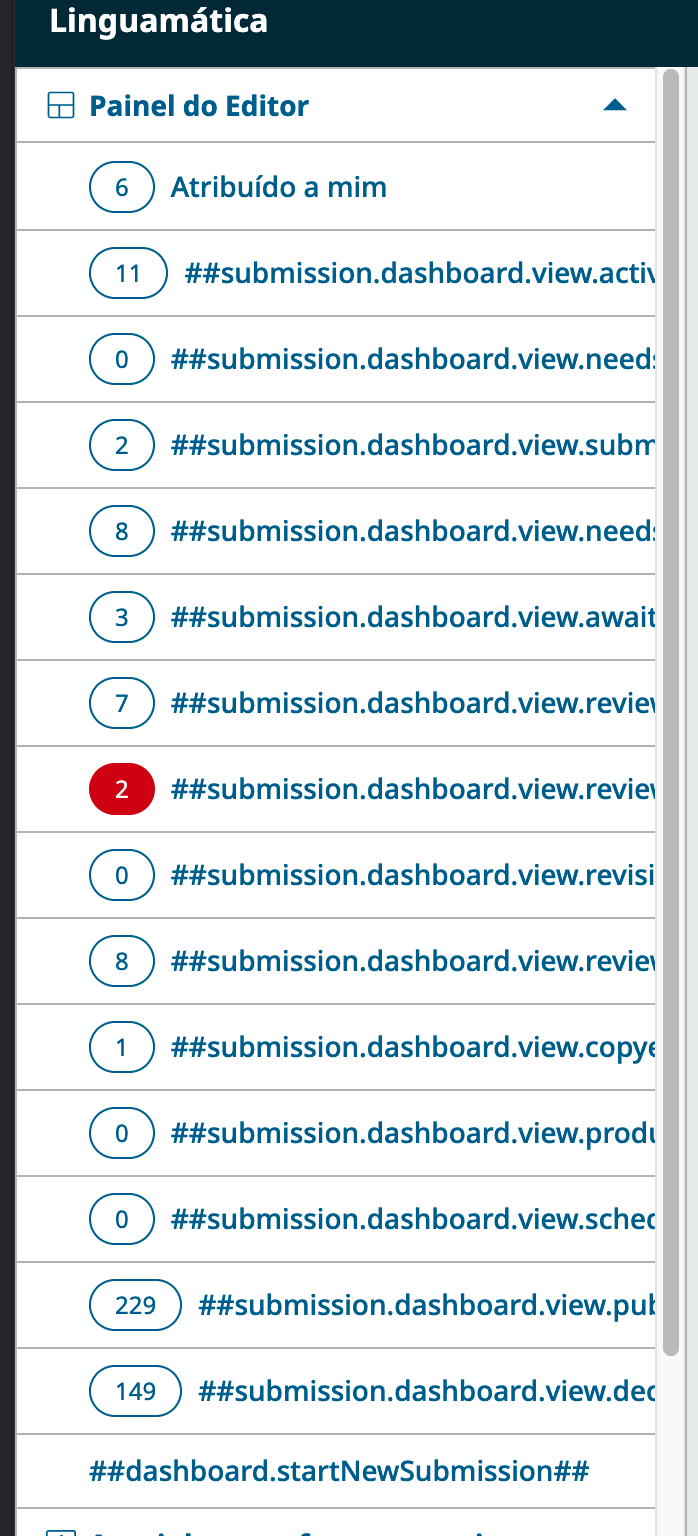
Thanks for your answer. Meanwhile I found the site, and noticed that most strings are translated. But my OJS dashboard is pretty untranslated.
What is the proper way to get translations from Weblate to my docker installation?
Thank you,
Hi @ambs,
This isn’t docker-specific, but a good first step to try might be uninstalling/re-installing your PT locale within the OJS interface. Which version of OJS are you working from?
-Roger
PKP Team
I am using docker for 3.5. Thus, I should mount the locales in a RW volume, and use the UI to update. Is this the standard approach?
Is there a way to find all volumes that will be written, so I can put them outside the docker image?
Thanks
Hi, @rcgillis
Even inside docker, I tried to remove and install the locale. It didn’t complain, so something should have been done. Nevertheless, nothing changed. I am not sure if OJS fetchs it from the web or just uses whatever is has local.
Thanks
Hi,
Sorry in advance if I over explain myself but I wan’t to be sure we are in same page. 
To translate the last OJS version (3.5), the recommended way is using weblate.
The tool will assist you in the process and coordinate with other translators.
After this Alec manually packages all the OJS releases including the new language improvements.
Here you have more information about the process:
This process have some benefits, but also some downsides:
You all the support weblate offers during translation… but you are kind of “blind translating” because you can’t see the context of the strings or test how they look like in the app.
Weblate is the usual-recommended workflow… but there is also an alternative: You can commit your lang files directly to OJS repo. Committing to repo is, by the way, the only option if you like to contribute to older OJS branches.
If you want to work without weblate, first step is be sure you are coordinated with the person or team that is maintaining the translation. If you are not, your work will collide with your fellows one.
Yes, for “non-weblate” translations, if you are working with “docker volumes for locales” will be also my election. What it’s not clear to me is what do you mean by “use the UI to update” as in 3.5 (if I recall well it was removed in 2.x) there is no translation plugin any more.
So, the process will be: Set your environment > Edit your lang files > Commit to your OJS fork > PR to PKP repo.
Even inside docker, I tried to remove and install the locale. It didn’t complain, so something should have been done. Nevertheless, nothing changed. I am not sure if OJS fetchs it from the web or just uses whatever is has local.
As far as I know, when you remove a locale from the webUI, the files are NOT deleted but lang is disabled. But when you install from the webUI, the files are downloaded from OJS repos again and updated.
Notice the downloaded version will be the last packaged, but could be unsync with the one in weblate, so this is why contacting with lang coordinator is so important and weblate is the recommened way.
About your issue… probably a cache is interfering here… Did you try cleaning OJS and your local caches?
PS: A mention to @asmecher to confirm he agrees in the working proposal.
Hi, @marc
Thanks for your answer. I understand the workflow. I was expecting regular ojs3 releases with translation data being updated as it is available. I am using the latest image, 30 days old. So, I am trying to understand what am I missing
I am not sure if OJS fetchs it from the web or just uses whatever is has local.
“…when you remove a locale from the webUI, the files are NOT deleted but lang is disabled. But when you install from the webUI, the files are downloaded from OJS repos again and updated.”
If you have downloaded the translations again, my guess is that there is a cache problem (local or server). Have you been able to rule out that problem?
I was expecting regular ojs3 releases with translation data being updated as it is available. I am using the latest image, 30 days old. So, I am trying to understand what am I missing.
“Latest” image tag is an alias for “ojs:3_5_0-3-php8.3-mod-20260112-1245” so, unless there was any packaging error during the release (in mine or Alec’s side), the image should include one month old PT-PT lang files. Anyway, you can always ask OJS to update your langs as explained before.
But I’m not sure how do you know you have old strings… I mean the untranslated strings you show in the screenshot could be related with the cache issue I mention.
I apologize if I read it too quickly and missed something.
Cheers,
m.
Hi
I might be reading things too fast as well. Unfortunately my main job is not related to Academy, and I am just trying to keep things running
I cleared all caches on the site administration panel, and local caches. The untranslated messages are still there.
I can confirm the packaged po file for pt (European) misses one of the entries from the admin menu:
www-data@7292dd290dbf:~/html$ cat lib/pkp/locale/pt/submission.po |grep startNewSubmission
www-data@7292dd290dbf:~/html$ cat lib/pkp/locale/pt_BR/submission.po |grep startNewSubmission
msgid “dashboard.startNewSubmission”
And confirmed Weblate is missing this translation.
Will try to add that info to Weblate, expecting things get updated in the next package, asap.
Thanks
@marc, weblate has pt and pt_PT as two distinct languages in some places. For example, for PKP Web Application Library @ Weblate
Now I am lost on where I should translate, and not sure if I was having work translating in the wrong place.
Also, my lib/pkp/locale folder has a pt_BR and pt, but not pt_PT.
Thanks
Hi @ambs
Also, my lib/pkp/locale folder has a pt_BR and pt, but not pt_PT.
Yes, this is a change introduced in 3.5.
In short, “pt” is now the “Portuguese from Portugal” locale, so work in the pt folder.
The fact is now some codes follow the “2charLang_2charsRegion” format (pt_BR), while others are just 2 chars lang (pt). The argument for this is the 2 code lang aligns better with modern internet approaches, although I’m the worst person to ask about this.
More info about the lang codes here.
But please, try to contact the “pt” (aka. pt-PT) lang coordinator before starting your work to avoid collisions. You can usually find their mails in the lang files or in weblate.
I left a message in the internal mattermost channel, pointing to this post too.
Cheers,
m.
@marc, I am unable to find the name/contact of the responsible for the pt(_PT) translation.
Are you able to help?
I don’t know either, but let’s asked @EmmaU that is the general coordinator of translations.
She is in a different timezone, so let her at least 24h.
Anyway, thanks a lot for your time and dedication to this Alberto.
BTW, any other doubts about how to proceed?
Did you manage to work in the translations over your docker instance?
Cheers,
m.
Hi, @marc. I would prefer to make my effort on Weblate, and have the translations be shipped officially in the next docker image update. Meanwhile, I will make pt_BR available in my journal as a temporary measure.
Sorry for the delay! There is no coordinator that I am in contact with, but checking the activity history on Weblate, it seems @josekarvalho has been working on it most recently. It might be worth reaching out to him to see if there is any opportunity to collaborate on pt_PT!
Hi, yes, I colaborate mainly on the OJS/OMP translation to portuguese (from Portugal), yet, there is no coordinator. We have mainly focus our efforts on the 3.3 and 3.4 versions and plan to focus very soon on 3.5 version.
@ambs In weblate, there are two different projects por pt and pt_PT
https://translate.pkp.sfu.ca/languages/pt_PT/
https://translate.pkp.sfu.ca/languages/pt/
Our focus is to review the translations in this last project in the next 2-3 months.
Regards,
José Carvalho
Hi, José.
Thanks for the feedback. I will translate strings from 3.5, then, expecting I can help shipping the translations as soon as possible.
I wonder if there are translations from pt_PT we can import directly in pt? It would be nice to have that migration in place, expecting it saves us some efforts
Anyway, keep me in the loop. Looking forward to help.
Translation of PKP Web Application Library is ready.
It seems that OJS is almost done as well in Weblate.
What is the process to request a new docker image, with updated L10N documents?