Hi
I have a problem.
when our reviewers click on the {$reviewAssignmentUrl}, they encounter a 404 error.
This problem also apears for all URL links such as {$submissionsUrl}, {$journalUrl} etc.
Could you please help me for solving this problem?
Thank you very much
We’re also facing this issue where the $reviewAssignmentUrl is seemingly not replaced correctly.
What version of OJS are you using?
3.5
Thank you for your kindely helping
Hi @mybh,
It looks from your other thread like you might be copying and pasting the {$reviewAssignmentUrl} placeholder as though it’s an actual URL. This variable should be replaced with the actual URL when the email is delivered, and will only be available to the reviewer receiving the message.
Can you confirm what the email looks like when the reviewer receives it?
Regards,
Alec Smecher
Public Knowledge Project Team
Dear @asmecher,
Thank you for your respone.
What do you mean “actual URL”?
Could you please explain me this with an example?
Sincerely…
Hi @mybh,
What I mean is that you can’t get the reviewer’s link to the submission from the OJS interface – you will only ever see {$reviewAssignmentUrl} there. That’s intentional so that the editor can’t e.g. steal an access key, which might be part of the link. You can only get the real link from the email message that’s delivered to the reviewer. What does that link look like?
Regards,
Alec Smecher
Public Knowledge Project Team
Hi @asmecher
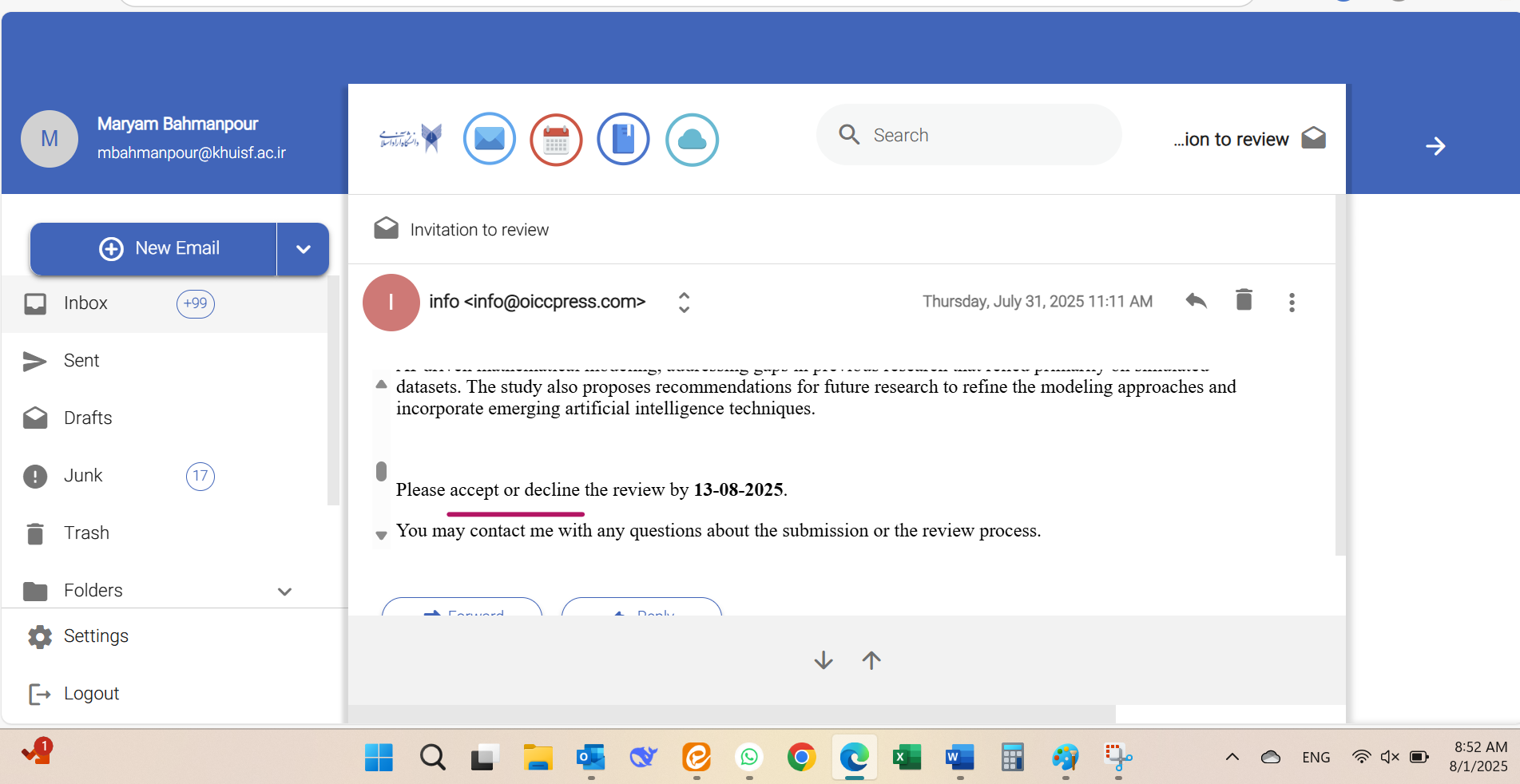
As I indicated in red in the image, by placing {$reviewAssignmentUrl} in the Template, there is no link to click in the email.
Thank you very much
Hi @mybh,
What does the allowed_html setting in your config.inc.php configuration file contain?
Regards,
Alec Smecher
Public Knowledge Project Team
Hi @asmecher we have the following which are the defaults as far as I know:
; Allowed HTML tags for fields that permit restricted HTML.
; Use e.g. "img[src,alt],p" to allow "src" and "alt" attributes to the "img"
; tag, and also to permit the "p" paragraph tag. Unspecified attributes will be
; stripped.
allowed_html = "a[href|target|title],em,strong,cite,code,ul,ol,li[class],dl,dt,dd,b,i,u,img[src|alt],sup,sub,br,p"

; Allowed HTML tags for submission titles only
; Unspecified attributes will be stripped.
allowed_title_html = "b,i,u,sup,sub"

;N.b.: The implicit_auth parameter has been removed in favor of plugin implementations such as shibboleth
Also I didn’t realise but @mybh and I are working from the same publisher
Thanks!
1 Like
Hi all,
It looks to me like the underlying problem is that something is stripping the links out of the email when it’s being sent – there should be several links in the reviewer invite email, but it looks like possibly all of them are getting stripped out.
Do you see any links in that email message? If not, what about other messages that OJS sends out?
The configuration you quoted above looks fine.
Regards,
Alec Smecher
Public Knowledge Project Team
Dear @invisibledragon
Please reply. I don’t have access.
Hi all,
Following up where I can on this - For some reason the variable is being replaced now, and with a blank link is not appearing.
So the template source code before we press “Send”:
<p>Dear {$recipientName},</p>
<p>I believe that you would serve as an excellent reviewer for a submission to International Journal of Mathematical Modelling & Computations. The submission's title and abstract are below, and I hope that you will consider undertaking this important task for us.</p>
<p>If you are able to review this submission, your review is due by {$reviewDueDate}. You can view the submission, upload review files, and submit your review by logging into the journal site and following the steps at the link below.</p>
<p><a href="{$reviewAssignmentUrl}"><strong>Mathematical Modeling of Hepatitis C Virus: Transmission and Control</strong></a></p>
<p><strong>Abstract</strong></p>
<p>The Hepatitis C virus (HCV) remains a huge public health issue globally, affecting roughly 71 million individuals with chronic infections. We built a mathematical model to mimic the transmission dynamics and control of HCV to inform effective control techniques. Our compartmental model integrates essential elements affecting HCV transmission, encompassing susceptible, latent, acute, and chronic infections, as well as hospitalized and recovered people. Conventional methods for managing the spread of the hepatitis C Virus (HCV), including screening, treatment, and harm reduction efforts, have demonstrated poor efficacy in mitigating the virus's spread. This paper aims to rectify these limitations and gaps with a deterministic compartmental model. Our model emulates the reported epidemiological trends of HCV in several contexts by utilizing parameter estimates from the literature and country-specific data. In the analysis of the model, we test for the positivity of the model, which verifies that the equations used in this model are positive for all t ≥ 0. From the disease-free equilibrium state, it was shown that the virus may die off in all the epidemiology classes except for the susceptible individuals. The model's reproductive numbers were calculated and demonstrated that indicating global stability and the eventual extinction of the illness over time t. The model was executed and validated by simulations across diverse demographic segments, indicating that the virus will be managed with governmental action. Sensitivity analysis identified key drivers of transmission, including injection drug use and inadequate infection control practices in healthcare settings. The optimal control strategy for Hepatitis C involves balancing the efforts to reduce the transmission and increase recovery. Implementing controls and can reduce the prevalence of both acutely and chronically infected individuals while accounting for the associated costs of these measures. The numerical simulations illustrate the efficacy of the optimal control technique in managing Hepatitis C. Our results suggest that combining these interventions can significantly reduce HCV prevalence and incidence. Specifically, increasing recovery coverage to 80% and efforts to reduce the transmission by 50% can reduce chronic HCV infections by 55% over 40 months.</p>
<p><strong>Keywords: </strong>Hepatitis C Virus (HCV), Endemic, Equilibrium, Sensitivity analysis, Basic reproduction number</p>
<p>Please <a href="{$reviewAssignmentUrl}">accept or decline</a> the review by <strong>{$responseDueDate}</strong>.</p>
<p>You may contact me with any questions about the submission or the review process.</p>
<p>Thank you for considering this request. Your help is much appreciated.</p>
<p>Kind regards,</p>
<p>Dr. Maryam Bahmanpour</p>
And then what is sent out is as follows:
<p>Dear joe joe,</p>
<p>I believe that you would serve as an excellent reviewer for a submission to International Journal of Mathematical Modelling & Computations. The submission's title and abstract are below, and I hope that you will consider undertaking this important task for us.</p>
<p>If you are able to review this submission, your review is due by 25-08-2025. You can view the submission, upload review files, and submit your review by logging into the journal site and following the steps at the link below.</p>
<p><a href=""><strong>Mathematical Modeling of Hepatitis C Virus: Transmission and Control</strong></a></p>
<p><strong>Abstract</strong></p>
<p>The Hepatitis C virus (HCV) remains a huge public health issue globally, affecting roughly 71 million individuals with chronic infections. We built a mathematical model to mimic the transmission dynamics and control of HCV to inform effective control techniques. Our compartmental model integrates essential elements affecting HCV transmission, encompassing susceptible, latent, acute, and chronic infections, as well as hospitalized and recovered people. Conventional methods for managing the spread of the hepatitis C Virus (HCV), including screening, treatment, and harm reduction efforts, have demonstrated poor efficacy in mitigating the virus's spread. This paper aims to rectify these limitations and gaps with a deterministic compartmental model. Our model emulates the reported epidemiological trends of HCV in several contexts by utilizing parameter estimates from the literature and country-specific data. In the analysis of the model, we test for the positivity of the model, which verifies that the equations used in this model are positive for all t ≥ 0. From the disease-free equilibrium state, it was shown that the virus may die off in all the epidemiology classes except for the susceptible individuals. The model's reproductive numbers were calculated and demonstrated that indicating global stability and the eventual extinction of the illness over time t. The model was executed and validated by simulations across diverse demographic segments, indicating that the virus will be managed with governmental action. Sensitivity analysis identified key drivers of transmission, including injection drug use and inadequate infection control practices in healthcare settings. The optimal control strategy for Hepatitis C involves balancing the efforts to reduce the transmission and increase recovery. Implementing controls and can reduce the prevalence of both acutely and chronically infected individuals while accounting for the associated costs of these measures. The numerical simulations illustrate the efficacy of the optimal control technique in managing Hepatitis C. Our results suggest that combining these interventions can significantly reduce HCV prevalence and incidence. Specifically, increasing recovery coverage to 80% and efforts to reduce the transmission by 50% can reduce chronic HCV infections by 55% over 40 months.</p>
<p><strong>Keywords: </strong>Hepatitis C Virus (HCV), Endemic, Equilibrium, Sensitivity analysis, Basic reproduction number</p>
<p>Please <a href="">accept or decline</a> the review by <strong>18-08-2025</strong>.</p>
<p>You may contact me with any questions about the submission or the review process.</p>
<p>Thank you for considering this request. Your help is much appreciated.</p>
<p>Kind regards,</p>
<p>Dr. Maryam Bahmanpour</p>
I’ll try to dig into this further myself, but any assistance from @asmecher would be appreciated
Some further information I found, but I don’t know enough about OJS any further:
On the invitations table, entries are being created but their key_hash is null, and payload is {“reviewAssignmentId”:null} with their status being INITIALISED and no further than this,
I’m trying to follow through in the code but it is quite tricky to understand all of the hoops when assigning a reviewer within the platform
Hi @invisibledragon - what version of OJS are you working on? A similar problem is fixed in the latest version (3.5.0-1). (see One click reviews in OJS 3.5 and also this issue [Invitations] | Reviews - One Click Login for reviewers don't work when inviting a new reviewer · Issue #11613 · pkp/pkp-lib · GitHub)
@Dimitris_Efstathiou We are using 3.5.0.1, there is indeed a review link in invitaiton letter, some reviewers can open the link directly without login, but some can not which display 404 not found. In addition, the reviewer can not open again when uploading review comments. What is the problem?
At the moment we’re (OICC) on 3.5.0 without the -1 as I’ve done some changes elsewhere to the live version.
I will see if that issue I can patch in, until I can create a clean upgrade to 3.5.0-1 or a later release as I wouldn’t want to loose any changes we’ve made
1 Like
Thanks @invisibledragon! there is a very quick fix here if you have access to your code.
1 Like
@Haylee_Lin thanks for the reply!
The URL included in the invitation email uses the One-Click-Review feature. This means that the link is only valid for a single use - once the reviewer clicks it and is logged in, the link becomes invalid. Any further attempts to use the same link will result in a 404 Not Found error.
If reviewers need continued access, they should log in through the regular login page after the initial access.